
Hello everyone; It's been a long time since I posted anything of note here, but a family trip to Gettysburg is plenty of reason now.
On July 18, 19 and 20th my boys (Josh 19 years old and Chris 15) and I, plus Josh's girlfriend, Nicole took a weekend trip to Gettysburg. We were joined by my sister Gina and her husband John and her two sons (Jonathan 16 yrs old and Matt, 13). I had been to Gettysburg twice before but years ago. Nobody else in our group had ever been there, so it was a real trip of discovery.
To be honest, the draw to the kids for this visit was two Ghost Tours we went on Friday and Saturday night. What they also learned was that a battle of immense proportions was fought here, highlighted by acts of bravery and heroics in conditions the kids would never want to face, as well as immense tragedy and loss. And it's only an hour and a half from here.
Major General Joshua Chamberlain says it best in the photo up above. This was taken by Nicole at the Gettysburg Visitors Center. I'll write out below, what is written in the first photo, it's almost like he knew we were coming and "ghost hunting" as well as touring the battlefield was on our itinerary.
"
In great deeds something abides. On great fields something stays;Forms change and pass, bodies disappear, but spirits linger.....And reverent men and women from afar, and generations that...we know not of.....(are) drawn to see where...great things were suffered and done for them..."A great place to start any visit to the battlefield, that had the kids amazed at how many people were there. "Yes kids, Mr. Joe is not the only history buff in the world":-)
Actually, lets back up to Friday night, when we got there.
We stayed at the Hilton Garden Inn, right on Route 30 and just minutes from downtown
All the modern amenities as well as an indoor pool and jacuzzi. We made sure the 5 kids had time to enjoy that.
On Friday night, we went on a Ghost Tour train ride, along the edge of the battlefield and to an old engine house, that has been the site of paranormal activity. It was a nice, but pricey trip.
Below is the engine and a bit of the passenger cars. There was full narration by the guide as we rolled along, lots of good stories about the battle and paranormal activity.

The train pulled into the engine house and a CD was played featuring Ghost Hunter and Author; Mark Nesbitt. On the CD were tracks that featured ghostly answers to his questions.
On this tour, Josh and Nicole did not join us, as Josh had to work till 5pm and wouldn't be getting to G-Burg until 8PM. The photos below are of the train station (circa 1880s), Chris and Jonathan checking text messages or photos on a cell phone and a bit of the countryside as we rolled through it. This farm was used as a hospital during the battle.


But when we got back to the station we called Josh and he and Nicole met us for dinner. Earlier, before the train ride, the six of us walked around the heart of Gettysburg, visited a few shops and got our bearings. Gettysburg is a great small city, that's very clean, very friendly and with plenty of shopping and restaurants.
Dinner was right downtown at a place called "The Pub" and was a welcome break to the chain restaurants we normally go to. We took up two tables, with the four boys at one table and Nicole sitting with John, Gina and I. One glance at the boys table, shows another reason why we came here, the boys have such a great time together, they are always all smiles when they're together.
On Saturday, we all went to the Gettysburg Battlefield, starting with the brand new Visitors Center.
The Visitors Center is very large and very well done. We spent about an hour in there, including watching a 15 minute movie narrated by Morgan Freeman. It was well done, fast paced and kept the kids attention, while at the same time setting the framework for our tour of the actual battlefield.
Pictured below is the visitors center, and displays inside of it. Everywhere you looked there was something to see and many stirring stories of what it was like for soldiers and civilians in that battle. For the kids, this was a chance to see actual items used in the battle and found on the battlefield. Seeing an actual flag that flew in 1863 for a Union or Confederate regiment is a great history lesson.


After the visitors center we caravaned along the park roads, Gina, John and their boys in their jeep and me and my crew in the van. There are over 15 stopping points in the park, plus many more areas to pull over and look at a monument or statue.
Speaking of monuments, the shear number of them, placed by individual regiments or units or states involved is amazing. And many of them were erected in the 1880s or early 1900s, which also amazed the kids. I imagine the kids think that life was rustic and people lived in log cabins up until the 1970s. Just today (July 28th) Nicole mentioned how much she liked the various statues and the craftsmanship put into them and how good they looked for being made so long ago.
The picture below is of the 5 kids in front of the spot where Union General John Reynolds was fatally shot, while directing his troops on the first day of battle.
In the back row, from left to right, you have Christopher, Josh and Jonathan and in front you have Nicole and Matt. The second photo is myself, Josh and Chris.


The parts of the battlefield we toured that Saturday morning/ mid-afternoon was the scene of the first days fighting. Pictured below are some of the sites along the tour road.
First photo is a monument erected by veterans of a Pennsylvania Volunteer Regiment.

Second photo is one of two observation towers, gave us a great birdseye view of the surrounding area.

Third photo here is looking down at some of the numerous monuments to regiments and other units, that fought in this part of the battle. The monuments are overwhelmingly Union, since it was a Union victory on Northern soil. But at the end of the first day that victory was the farthest thing from the yankees mind.

By 2:00 pm, we were all getting hot and hungry, so we decided to take a break and get some lunch down in Gettysburg and then head back to the hotel so the kids could get some pool time in.
Later that night, we were due for a ghost tour put on my "Ghosts of Gettysburg, Candlelight Walking Tours"
I think I'll post this for now and come back in a day or two with the next chapter of our story.
Mr. Joe
 attlefield stops we made.
 North Carolina Memorial, looking across the battlefield to the Union lines.


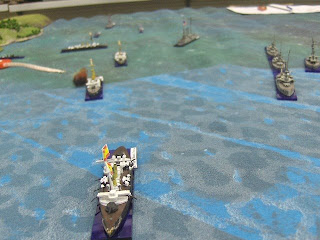
 The American noose tightens, as the Spanish ships make a turn to starboard upon exiting the harbor entrance. As the range closed, the negative modifiers started changing to positive modifires and that meant trouble for the Spanish ships. By turn 6, the Cristobal Colon had some major damage and Critical Damage, which effected it's speed and turning ability. The Viscaya had also been hit.


 By turn 8, the Furor was sunk by the combined gunfire of the Armored Cruiser USS New York and the Armed Yacht Vixen. Here's an 1898 illustration of the TBD Furor being pursued.


 In the next picture, the Spanish Squadron led by the Flagship, Infanta Maria Teresa steam out of Santiago harbor, flags proudly flying, all hands at their stations
 If you notice the fort on the hill, overlooking the entrance to Santiago harbor, that came from a visit by me to the life size version in Old San Juan Puerto Rico in April 2006. The name of the fort is Il Moro and it's a great place to visit. Being a wargamer, I just had to buy that miniature fort for future use and so it came to be.

 Admiral Cervera was Les Mansir; here's a photo of Les, going over his ship stats.
 As the Spanish ships come out, the lead ship Infanta Maria Teresa, fires it's forward main gun at the American ships. Golf tees serve as shell splashes. (a great idea by Dick Caldwell) The Spanish Armored Cruisers main armament consisted of a single turret fore and aft with a single 11" gun.
 The Americans respond in kind with a few more shell splashes. 12" and 13" guns on the Battleships, 8" main guns on the Cruisers.


 Indy's a good helmsman and the two ships just missed each other. In real life, the Texas had to do an emergency reverse to avoid a collision. On the bridge of the Brooklyn, when the crew said to Commodore Schley, "Sir, watch out for the Texas", Schley (his blood was up) "Damn the Texas, let her watch out for herself."
 Looking a bit closer at some of the ships; Here's the Brooklyn, which unfortunately came to me in 2004/2005 without it's main gun turrets. Someday I'll get around to contacting the manufacturer and getting them.
 Here's the Almirante Oquendo. My research shows this to be the color scheme of the Spanish navy then.
 This is one of the American Battleships (The Oregon). In real life, this ship sailed all the way from Puget Sound-Seattle in Washington State to Jupiter Inlet in Florida, a journey of 14,700 nautical miles and she did it in 67 days. Also remember that back then, ships burned coal and so that meant stopping and re-coaling along the way. Burning 10 tons of coal an hour for an average speed of 12 knots, the "black gang" had to keep the hungry fireboxes fed for two months, around the clock, using only shovels

 I think I will close and publish this post for now and come back to tell the rest of the story next week. Here's some final photos of the Spanish ships making their way out of the harbor and the poor little Pluton getting rocked by near misses.
